
Seminar "Selected Topics in Medical Signal Processing"
| Basic Information | |
|---|---|
| Lecturers: | Gerhard Schmidt and group |
| Semester: | Winter term |
| Language: | English or German |
| Target group: | Master students in electrical engineering and computer engineering |
| Prerequisites: | Fundamentals in digital signal processing |
| Registration procedure: |
If you want to sign up for this seminar, you need to register with the following information in the form
Please note that the registration period starts 05.10.2026 at 08:00 h and ends 23.10.2026 at 23:59 h. All applications before and after this registration period will not be taken into account. Registration will be possible within the before mentioned time by sending an e-mail with the desired seminar topic, name and matriculation number to Only one student per topic is permitted (first come - first serve). The registration is binding. A deregistration is only possible by sending an e-mail with your name and matriculation number to |
| Time: |
Preliminary meeting per arrangement with individual supervisor Written report due on 07.02.2027 Final presentations, 10.02.2027 (preliminary) |
| Contents: |
Students write a scientific report on a topic closely related to the current research of the DSS group. Potential topics, therefore, deal with digital signal processing related to medical signal processing. Students will also present their findings in front of the other participants and the DSS group. |
Topics for WS 26/27
| Topic title | Description |
|---|---|
| Uncertainty and Spatial Resolution in Non-Invasive Magnetocardiographic Imaging |
Non-invasive magnetocardiographic (MCG) imaging aims to characterize cardiac electrical activity by measuring the magnetic fields generated by the heart at the body surface. However, the inverse problem of reconstructing cardiac electrical activity from these measurements is inherently ill-posed, and the resulting maps are affected by measurement noise, sensor configuration, anatomical uncertainties, and limitations of the underlying forward model. In this seminar, you will investigate how different approaches characterize and address uncertainty and spatial resolution in non-invasive magnetocardiographic mapping. Based on a comparative analysis of research papers, you will examine the influence of sensor configuration, measurement noise, anatomical geometry, forward-model assumptions, and reconstruction methodology on the reliability and spatial resolution of cardiac magnetic maps. |
| Digital Training Applications for Home-Based Speech Therapy |
Continuous practice between therapy sessions is known to significantly improve the outcome of speech and voice therapy, yet patients rarely receive expert feedback outside the clinic. Digital training applications aim to close this gap by providing instantaneous, objective feedback based on real-time signal processing of the patient's speech. In this seminar, you will conduct a literature review on existing approaches for home-based speech and voice training systems, with a particular focus on the underlying signal processing pipeline: which acoustic features are extracted in real time (e.g., pitch, jitter, shimmer, formants, spectral measures), how these features are mapped to intelligible and motivating feedback signals, and which constraints (latency, robustness to background noise, computational complexity on mobile hardware) shape the system design. You will further compare how different systems adapt the training difficulty to the individual patient's progress and how the extracted signal features are logged to support longitudinal monitoring by the therapist. Your goal is a structured comparison of at least three approaches, highlighting trade-offs between signal processing complexity, real-time feasibility, and clinical usability. |
| Evaluation of Sensor Fusion for Magnetic Tracking in Medical Applications |
Magnetic tracking systems enable the position and orientation of medical instruments to be determined without requiring a direct line of sight. However, their performance can be affected by magnetic field distortions, sensor noise, and limitations of the tracking environment. Combining magnetic tracking with complementary sensing modalities may improve the accuracy and robustness of the resulting position and orientation estimates. In this seminar, you will investigate and compare different sensor fusion approaches that combine magnetic tracking with complementary sensing modalities, such as inertial measurement units (IMUs) or ultrasound-based information. The focus will be on evaluating how the additional sensor information affects tracking performance and under which conditions it provides a significant benefit. Relevant aspects such as position and orientation accuracy, robustness to disturbances, applied fusion methods, calibration requirements, and computational complexity should be considered. |
| Computational Methods for Clinical Gait Analysis |
Quantitative gait analysis provides detailed information about human movement and can support the assessment of movement disorders, disease progression, rehabilitation, and treatment outcomes. A wide range of computational approaches has been developed to extract clinically relevant information from gait data, ranging from conventional spatiotemporal and kinematic parameters to biomechanical models, state-space estimation, machine learning, and more recent representation-learning and foundation-model approaches. In this seminar, you will review and compare computational methods for clinical gait analysis. Particular emphasis should be placed on how different approaches represent and process gait information, which input data and sensing modalities they require, and how they are evaluated in clinical applications. You will discuss classical feature-based and model-based methods alongside modern data-driven approaches and critically assess their interpretability, generalizability, data requirements, and limitations. |
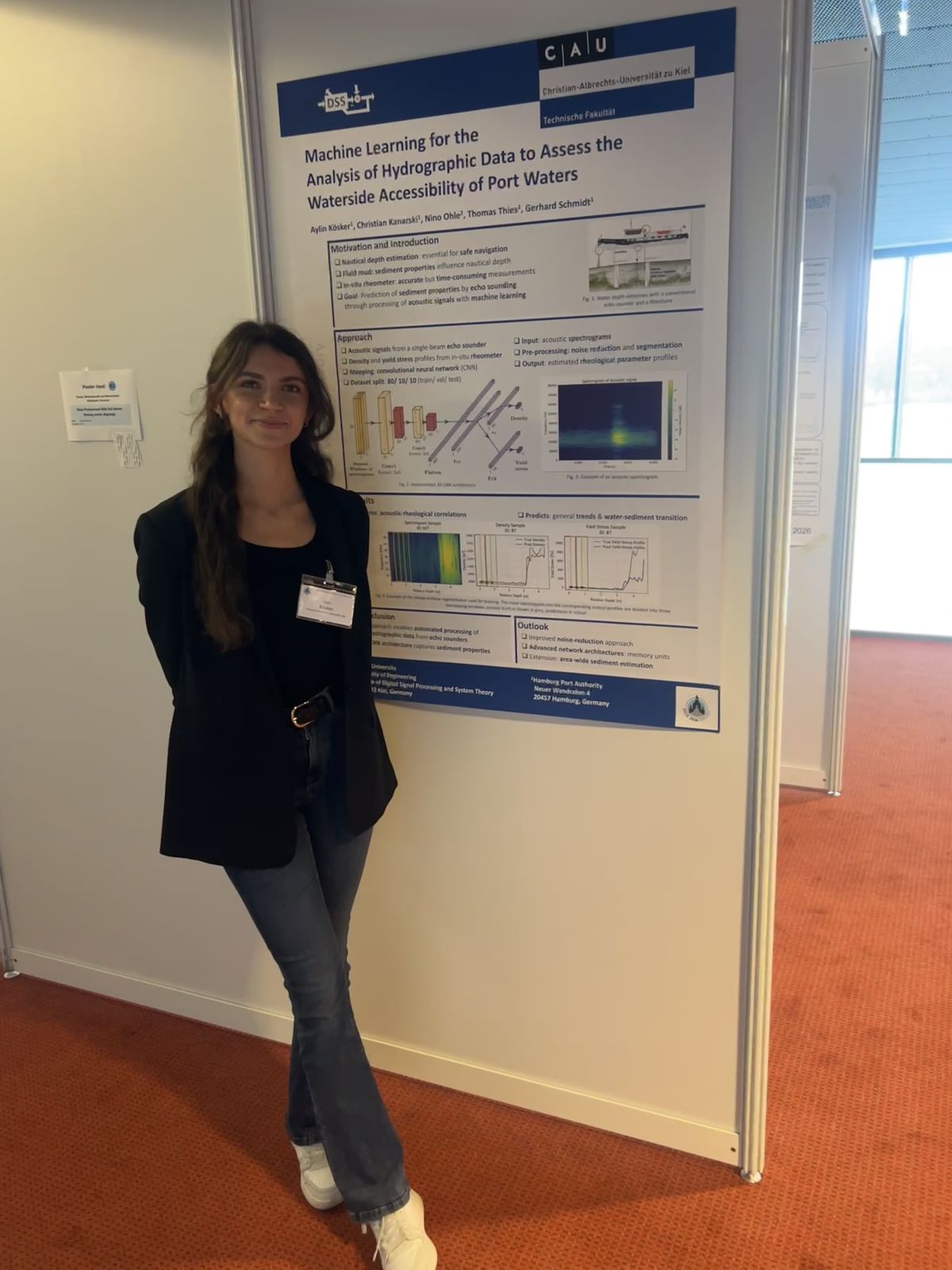 In March 2026, the DSS Chair attended the annual DAGA conference in Dresden. Thanks to the support of the GaS-Club, the student Aylin Kösker was given the opportunity to accompany the chair and participate in the conference from March 23rd to March 26th. As part of the daily poster sessions, she presented the results of her bachelor’s thesis “Machine Learning for the Analysis of Hydrographic Data to Assess the Waterside Accessibility of Port Waters” in the field of Underwater Acoustics. The thesis forms an important basis for an ongoing university research project on the acoustic analysis of sediment properties in harbor areas. The poster session enabled valuable discussions with researchers and conference participants from related research fields.